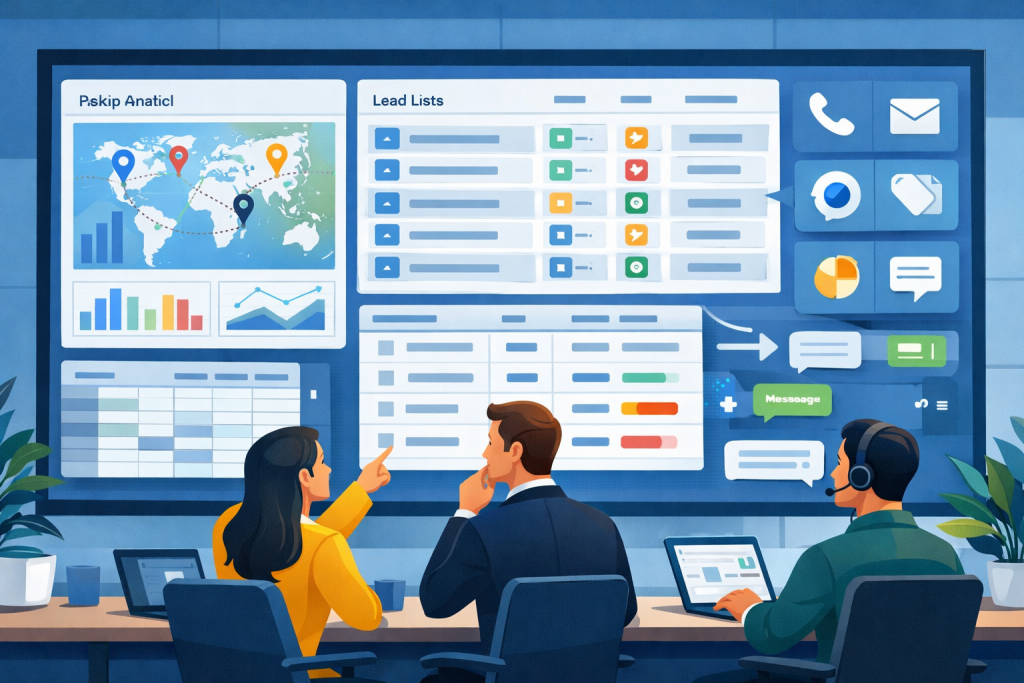
Why competitor analysis should guide B2B prospecting
In B2B sales, the biggest productivity question is not simply how many companies your team can contact. It is which companies deserve attention first. Random prospecting, generic industry lists, and broad outreach often create activity without enough pipeline. Competitor analysis changes that. By studying where competitors are positioned, which segments they serve, and what digital signals appear in the market, you can identify companies that are more likely to understand your value proposition.
The goal is not to copy a competitor’s customer base or start a price war. The goal is to understand demand patterns. If several competitors are active in a specific industry, city, company size, or use case, that market has already shown signs of need. With Business Monster, you can enrich that insight with business data, phone and email details, social accounts, Meta Pixel and Google Tag detection, Excel export, and WhatsApp tools. The result is a practical prospecting workflow, not just a research document.
What makes a company worth pitching?
A competitor’s presence in a market is only the first clue. To decide which companies should receive a sales offer, your team needs a set of qualification signals. These signals help separate high-potential accounts from companies that look similar but are unlikely to respond.
1. Similarity to your competitor’s ideal customer profile
If a competitor repeatedly targets manufacturers, clinics, logistics companies, agencies, or local retailers, that pattern tells you something about demand. You can look for similar companies in the same or adjacent markets. The best opportunities are often not the exact same accounts your competitor already serves, but companies with similar needs and fewer existing vendor relationships.
2. Evidence of digital investment
A company that uses Meta Pixel or Google Tag is usually measuring traffic, advertising performance, remarketing audiences, or conversion events. That does not automatically mean the company is ready to buy, but it is a strong signal of digital maturity. If your solution supports marketing, sales automation, analytics, lead generation, website performance, ecommerce, CRM workflows, or agency services, these companies may understand the problem faster than offline-only businesses.
3. Reachable contact channels
Great targeting is not useful if the sales team cannot reach the account. Phone numbers, email addresses, websites, and social accounts make outreach more realistic. Business Monster helps teams combine business data with phone/email information and social profile discovery so the prospect list is not just accurate, but actionable.
4. Active public presence
Companies that post on social platforms, update their websites, launch campaigns, or publish new services are often in a growth phase. A growing company is more likely to evaluate tools, vendors, and partnerships. Social accounts can also help your sales team personalize the message by referencing relevant business context instead of sending a generic pitch.
5. A gap where you can differentiate
The most attractive accounts are not always the largest ones. Sometimes your competitor is strong in enterprise accounts while smaller firms need a faster, simpler, or more affordable option. Sometimes the market has vendors but lacks better support, local expertise, reporting, integrations, or flexible onboarding. Competitor analysis should highlight where your offer is meaningfully different.
A practical workflow for building the target list
Competitor research becomes valuable only when it turns into a prioritized list. A structured workflow prevents the team from collecting too much information without taking action.
- Define competitor groups: Include direct competitors, alternative solutions, agencies, marketplaces, and companies competing for the same budget.
- Map their visible markets: Note the industries, regions, use cases, and company types they appear to target.
- Find lookalike companies: Use Business Monster business data to identify companies with similar industry and location characteristics.
- Enrich each record: Add phone, email, website, social accounts, Meta Pixel detection, and Google Tag detection where available.
- Score the opportunity: Rate each company based on fit, reachability, digital maturity, and differentiation potential.
- Export and execute: Use Excel export to move the list into your sales workflow, assign owners, and track outreach.
Which companies should receive a sales offer first?
The table below summarizes the account types that usually deserve priority when using competitor analysis for B2B opportunity discovery.
| Company type | Why it may be an opportunity | Best sales angle |
|---|---|---|
| Lookalikes of competitor target accounts | The need is likely validated by market activity | Focus on familiar pain points and a clearer alternative |
| Companies using Meta Pixel or Google Tag | They may already invest in digital campaigns and measurement | Discuss performance, tracking, automation, or lead quality |
| Companies with visible phone and email data | They are easier to reach through multiple channels | Combine email, calling, and structured follow-up |
| Companies with active social accounts | They care about visibility, engagement, or growth | Personalize outreach using current business context |
| Underserved small and mid-sized firms | They may need a simpler or more flexible solution | Emphasize speed, support, affordability, and onboarding |
How Business Monster turns research into outreach
Business Monster is useful because it connects multiple prospecting signals in one workflow. Your team can start with a market hypothesis, such as “regional logistics firms investing in digital marketing” or “retail brands with active social accounts.” Then you can use business data to identify relevant companies and enrich each record with phone and email information. Social accounts help sales representatives understand the company’s positioning, activity level, and potential priorities.
The platform’s Meta Pixel and Google Tag detection can be especially valuable for segmentation. A business with tracking tags is not just a name in a database; it may be actively measuring campaigns or preparing to scale digital acquisition. That signal allows you to create a more relevant offer. For example, a marketing technology provider can lead with tracking accuracy, while an agency can lead with campaign optimization or conversion improvement.
Once the list is ready, Excel export keeps the process operational. Sales managers can assign accounts, filter by score, group companies by region, and monitor outreach stages. WhatsApp tools can support quick follow-up, meeting reminders, and direct communication where appropriate. The key is to use these tools responsibly: targeted, context-aware messages usually outperform high-volume generic outreach.
How to write a better pitch using competitor insights
Competitor analysis should improve relevance, not make your message aggressive. In most cases, you do not need to mention a competitor by name. Instead, reference the market situation or the business problem. For example: “Many companies in your sector are trying to make digital campaign tracking and lead follow-up more measurable.” This creates a shared context without sounding confrontational.
A strong B2B message has three parts. First, include a relevant observation based on the company’s industry, location, social activity, or digital setup. Second, connect that observation to a specific business outcome such as more qualified leads, lower manual work, faster reporting, better customer response, or improved conversion tracking. Third, suggest a low-friction next step, such as a short call, an audit, or a demo.
Common mistakes to avoid
- Targeting everyone in the competitor’s market: Not every company in the same industry is ready to buy. Use digital and contact signals to prioritize.
- Relying only on company size: Smaller businesses with strong growth signals may convert faster than large but inactive accounts.
- Ignoring reachability: A perfect-fit account with no usable contact path can slow the sales process.
- Sending the same pitch to every account: Competitor analysis is valuable because it supports segmentation and personalization.
- Forgetting differentiation: If your offer sounds identical to the competitor’s, the prospect has no reason to switch or engage.
Conclusion: prioritize signals, not assumptions
Finding sales opportunities through competitor analysis is about converting market intelligence into action. The strongest prospects usually combine four elements: similarity to a proven customer profile, reachable contact information, signs of digital maturity, and a clear reason to choose your solution over alternatives.
Business Monster helps B2B teams build that process with business data, phone and email details, social accounts, Meta Pixel and Google Tag detection, Excel export, and WhatsApp tools. Instead of asking “Who should we pitch?” based on guesswork, your team can work from a prioritized list supported by measurable signals. That is how competitor analysis becomes a repeatable source of pipeline.