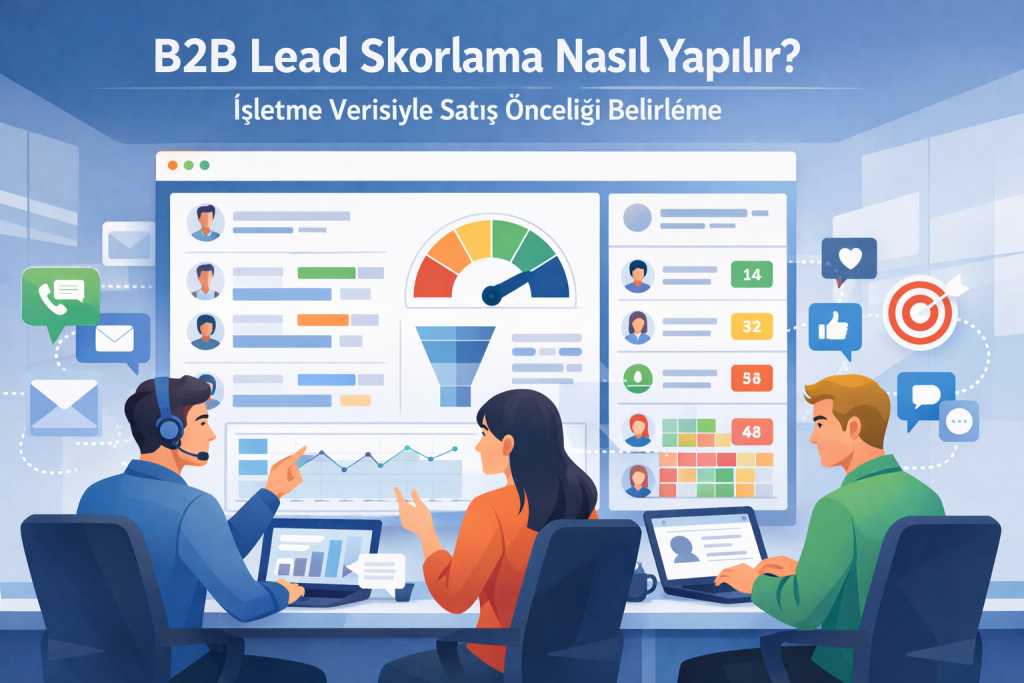
What is B2B lead scoring?
B2B lead scoring is the process of assigning points to prospects based on how likely they are to become qualified sales opportunities. Instead of treating every company in a database as equal, sales teams use a scoring model to decide who should be contacted first, who should enter a nurture sequence, and who should be deprioritized for now.
In B2B sales, time is usually the most expensive resource. A representative may have hundreds of company records, but only a limited number of calls, emails, or WhatsApp messages can be sent in a day. B2B lead scoring turns raw business data into a practical priority list. When signals such as industry, location, phone number, email address, social accounts, website presence, Meta Pixel detection, and Google Tag detection are analyzed together, the sales team can focus on accounts that fit the ideal customer profile and show signs of digital readiness.
Why business data matters in lead scoring
A good lead score is only as strong as the data behind it. If the database contains only company names, prioritization becomes guesswork. When the record includes contact information, categories, locations, websites, social profiles, and marketing technology signals, the score becomes more useful. Business Monster is designed around this idea: it helps teams collect and organize business data so that sales actions can be planned with more confidence.
For example, a company with a valid phone number and email address is easier to reach. A company with active social accounts may be more open to brand, marketing, or growth conversations. A website where Meta Pixel or Google Tag is detected may indicate that the business already invests in digital campaigns or analytics. None of these signals guarantees a sale, but together they create a stronger view of potential fit.
Define your ideal customer profile first
Before assigning points, define what a high-quality lead looks like for your business. A software company, an agency, a logistics provider, and a wholesale supplier will not score leads in the same way. Your ideal customer profile should include the characteristics that historically lead to better conversations, faster deals, or higher customer lifetime value.
- Target industries or business categories
- Preferred cities, regions, or service areas
- Minimum digital presence, such as a website or social accounts
- Required contact fields, such as phone and email
- Signals of marketing activity, such as Meta Pixel or Google Tag
- Company types that should be excluded or deprioritized
Once these criteria are clear, your B2B lead scoring model can be built around real commercial priorities rather than generic assumptions.
A practical B2B lead scoring framework
A simple rule-based model is often the best starting point. You do not need a complex predictive system on day one. Assign positive points to signals that increase sales potential and negative points to signals that reduce fit. Then group leads into clear priority levels, such as high, medium, and low priority.
| Signal | Suggested score | Why it matters |
|---|---|---|
| Matches target industry | +25 | Shows strong fit with your offer. |
| Phone and email available | +20 | Makes outreach faster and more flexible. |
| Website detected | +10 | Provides research context and digital presence. |
| Meta Pixel or Google Tag detected | +15 | Suggests analytics or advertising awareness. |
| Social accounts available | +10 | Creates additional engagement and research options. |
| Outside target region | -10 | May reduce operational or sales relevance. |
After scoring, you might classify leads above 80 as high priority, 50 to 79 as medium priority, and below 50 as low priority. The exact thresholds should be adjusted according to your sales capacity and conversion data.
How to use Business Monster in the workflow
Business Monster can support the lead scoring process at several stages. First, it helps you build a structured list of companies based on business data. Instead of manually searching for each prospect, you can work with richer records that include phone numbers, email addresses, social accounts, website information, and relevant digital signals. This creates the foundation for scoring.
Second, Business Monster’s detection of Meta Pixel and Google Tag can be especially useful for commercial research. If you sell advertising, analytics, CRM, automation, web design, or growth services, these signals may indicate that the business already understands the value of digital channels. That makes your outreach more relevant and allows the sales team to personalize the opening message.
Third, Excel export makes prioritization operational. Once leads are scored, exporting them to Excel allows managers and representatives to filter by score, city, industry, contact availability, or digital signal. A sales manager can distribute high-score leads by territory, while a representative can create a call list for the day. WhatsApp tools can then be used for fast outreach where appropriate, especially for leads that are easy to contact and have strong fit.
Recommended outreach by score level
Scoring should not end with a number. The score must guide the next action. High-priority leads deserve faster and more personalized outreach. Medium-priority leads may need education or nurturing. Low-priority leads can remain in the database for later campaigns or occasional review.
- High priority: Call first, then follow up with email or WhatsApp. Reference their industry, website, or digital activity.
- Medium priority: Add to a segmented email list, send useful information, and monitor for new signals.
- Low priority: Keep the record, but avoid spending direct sales time unless new data improves the score.
This approach prevents the sales team from using the same message for every prospect. A company with tracking tags and active social accounts may respond better to a digital growth angle, while a company with only basic contact information may need a simpler introduction.
Common mistakes to avoid
One common mistake is giving too much weight to a single data point. A phone number is valuable, but it does not automatically make a company a strong opportunity. Another mistake is ignoring negative scoring. If a lead is outside your service area or belongs to a low-fit category, the score should reflect that. Otherwise, your sales team may still waste time on accounts that are unlikely to convert.
It is also important to review the model regularly. Lead scoring is not a one-time setup. Sales outcomes should feed back into the scoring rules. If leads with Google Tag detection consistently book more meetings, increase the weight of that signal. If social account availability does not correlate with pipeline, reduce its importance. The best scoring models improve as real sales data accumulates.
Conclusion: prioritize the right accounts with better data
B2B lead scoring helps sales teams move from long, unfiltered lists to focused action plans. By combining business data, phone and email availability, social accounts, website signals, Meta Pixel and Google Tag detection, Excel export, and WhatsApp-based outreach workflows, Business Monster gives teams a practical way to identify which prospects deserve attention first. The result is not just a cleaner database; it is a more disciplined sales process, better use of time, and a higher chance of turning the right companies into customers.
